JUSTIN TYLER TATE
“ABAT-JOUR“
June 11 – August 30, 2026
Macaulay House Residence
Tr’ondëk Hwëch’in territory, Dawson City, Yukon
OPENING RECEPTION:
Friday, June 12th, 2025 7PM – 10PM
As part of the Yukon Riverside Arts Festival
Gallery-Hop
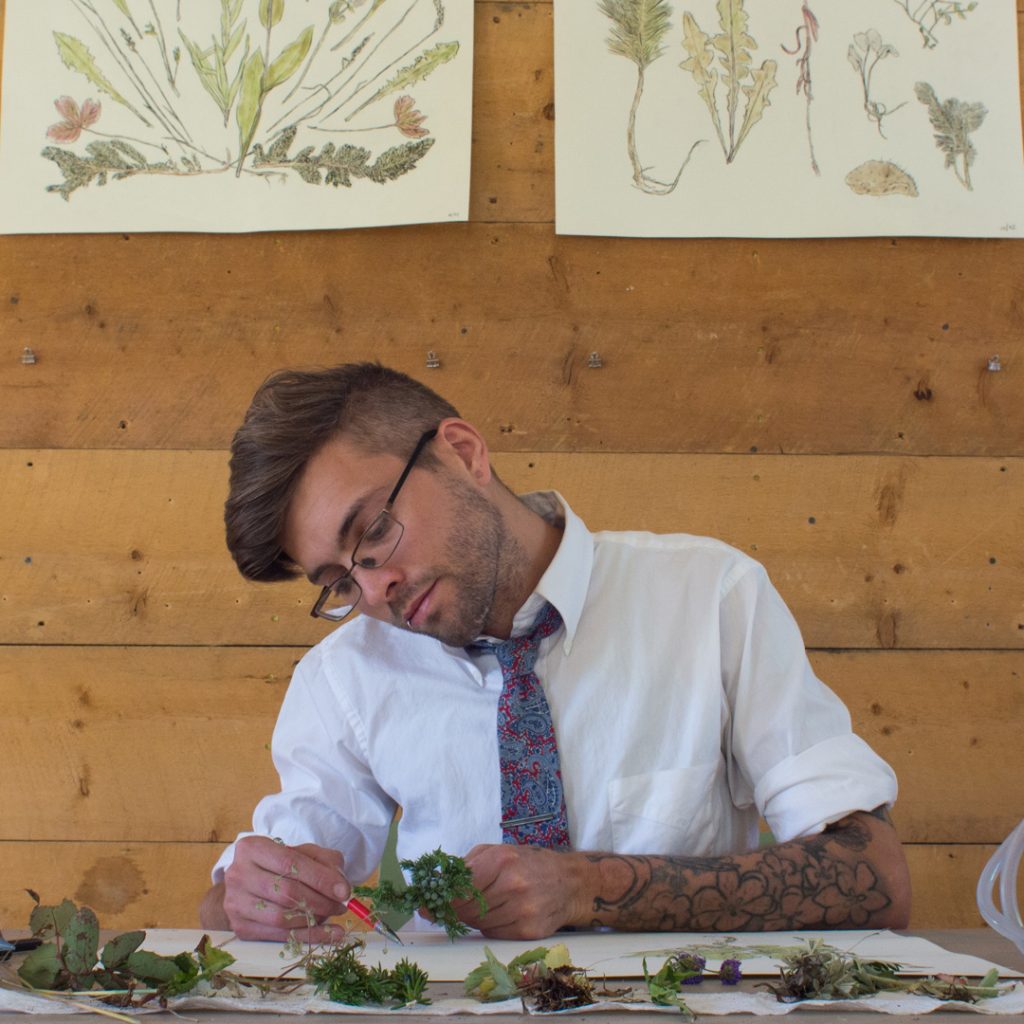
Re:Imagine | Re:Create is a public art initiative presented by the ODD Gallery in collaboration with STEPS Public Art that champions sustainability, creative reuse, and community engagement. The program commissions an artist with experience in reclaimed materials to create a site-specific installation using salvaged items from across Dawson City. Installed on the dike during the Yukon Riverside Arts Festival (June 12–15, 2025), the work will explore environmental responsibility and the social stories embedded in discarded materials, transforming them into accessible, thought-provoking public art.
ABAT-JOUR is a site-specific Post-Anthropocene Architecture built to house and enable the growth of local keystone, edible and medicinal plant species; whereby the architectural body functions as both a refuge for the transplanted flora, as well as an enabler of their reproductive capacities. The structure itself—with its central elevated ring of live plants surrounding an opening—allows for wind currents to flow underneath and up through the structure, propelling pollen and dispersing seeds beyond their typical capabilities. The structure also creates space for birds, insects and small mammals, which can find refuge in the structure’s interior or within its elevated garden. As such, the work acts as a collaborative endeavour between human and non-human, whereby the capacity of those endemic plants housed by the construction is boosted by the structure itself, as well as by providing niches for secondary inhabiting species to occupy. In doing so, the plant species are better able to spread out and occupy the work’s surroundings over time.
Plants included in the installation were gently and responsibly transplanted from the site of the June 2025 Dempster Corner Wildfire—where 19,545 hectares of forest near the Klondike Highway burned—as well as from within Dawson City limits. Plants were chosen specifically for their resilience, their importance to the surrounding ecosystem, in addition to their use as food, medicine or both. Examples of plants included in the installation include: bearberry, fireweed, Labrador tea, sphagnum mosses, wild rose, wild strawberry, and yarrow.
Many of these plants are considered pioneer species: the first plants to return following a significant ecological disturbance such as wildfire. While a burn zone may appear devastated, these early colonizers work to rebuild soil, hold moisture in the ground, and create conditions that allow other species to return over time. Their presence offers one of the earliest signs of recovery within a changing landscape.
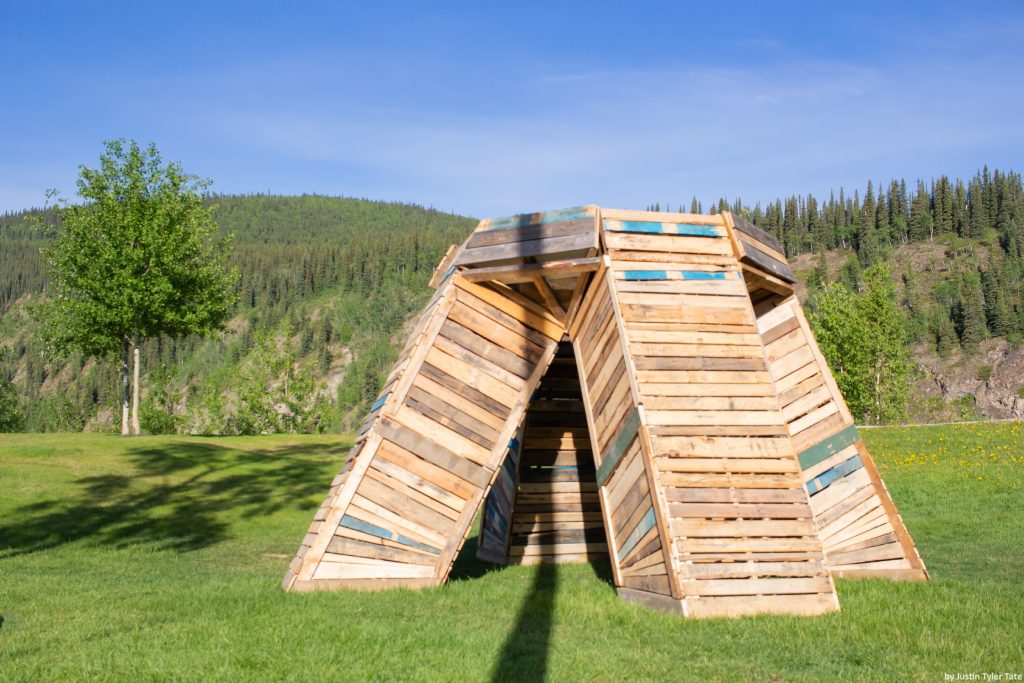
Photo my Justin Tyler Tate, June 2026
Justin Tyler Tate Justin Tyler Tate was born in Canada, grew up in the U.S.A. and now works internationally. Receiving his BFA from NSCAD University and a MFA from Helsinki Academy of Fine Arts, his work combines installation, media, performance and social art. Tate marries knowledge from various fields—architecture, carpentry, botany, cooking, electronics, chemistry, new-media, and more—in order to develop shareable solutions to contemporary problems. Tate is occasionally a curator, author, social designer as well as a facilitator of workshops which focus on available materials, tools and site-specificity.
STEPS (Sustainable Thinking & Expressions in Public Spaces)
This project is part of the CreateSpace Public Art Residency by STEPS Public Art , a national program bringing public art to communities across the country. The residency is supported by the Canada Council for the Arts, Canadian Race Relations Foundation with funding provided by the Government of Canada, and TD Bank Group through the TD Ready Commitment.
This project is supported by STEPS Public Art, the TD Bank Group through the TD Ready Commitment and the Canadian Council for the Arts.