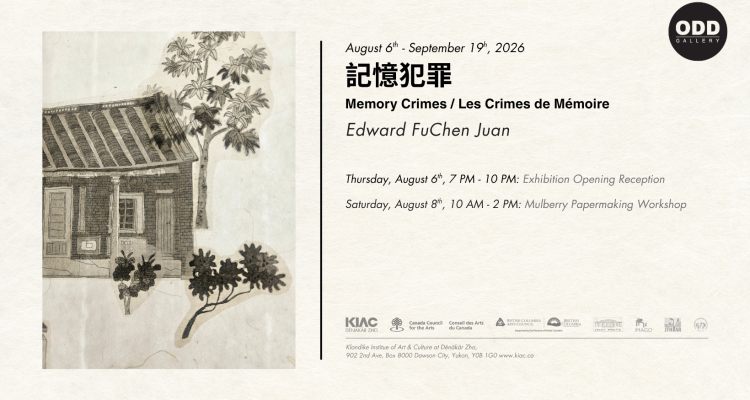
Dates: August 6th – September 19th, 2026
Gallery Hours: Tuesdays – Fridays: 10AM – 5PM & Saturdays: 12PM – 4PM
Location: ODD Gallery, Dënäkär Zho | KIAC
Indigenous Territory: Tr’ondëk Hwëch’in territory, Dawson City, Yukon
OPENING RECEPTION: Thursday, August 6th at 7PM – 10PM
WASHI PAPER MAKING WORKSHOP: Saturday, August 8th, 10AM – 2PM
Memory Crimes
English
In Edward FuChen Juan’s work, he focuses on materials manipulation and presents it through his approach to papermaking. By tracing the Taiwanese traditions of Gampi papermaking, his choice to print his intaglio engravings on paper produced by the paper masters at Goang Xing Paper Mill inscribes his artistic reflections into the work. As a member of the Taiwanese diaspora in Canada, Edward observes the challenges of truth and reconciliation in British Columbia, where he lives, alongside debates on transitional justice related to the beginning of the “White Terror” in 1947—a massacre of pro-democracy citizens that marked the onset of a violent dictatorial regime in Taiwan. The population called the mass arrests “Thought Crimes”, prosecutions without trials and due process. This memory appears on the paper through the representation of Taiwanese architecture linked to dispossession, as well as through a repossession of his family narrative that he inserts into his installation tapestry.
In Memory Crimes, the project finds its strength from the coexistence of collective and individual memories through the exploration of traditions. By developing expertise in papermaking, the artist incorporates plants endemic of Canada—notably beach grass and Douglas fir—layering and weaving the fibres of the territories he inhabits and lives within him, creating a paper house to foster new reflections on decolonization and healing.
Les Crimes de Mémoire
Français
La minutie traverse le travail d’Edward Fu Chen Juan. Son attention pour la matière – sa façon de la manipuler et de la présenter – se manifestent en premier lieu à travers son rapport au papier. En retraçant les traditions de fabrication du papier Gampi, entre autres à Taïwan, son choix d’imprimer ses gravures en intaglio sur un papier produit par les maîtres de Papeterie Goang Xing inscrit ses réflexions à même la matérialité de son œuvre. En tant que membre de la diaspora taïwanaise au Canada, Edward observe les défis de la vérité et de la réconciliation en Colombie-Britannique, où il vit, parallèlement aux débats sur la justice transitionnelle en lien avec la « terreur blanche » de 1947, un massacre de militant-es prodémocratie qui marque le début d’un régime dictatorial violent à Taïwan. Durant la «terreur blanche », des citoyens ont été emprisonnés sans mandat, pour ce que l’on appelle un « crime d’opinion » . Cette mémoire apparait sur la pulpe à travers la représentation d’une architecture taïwanaise liée à la dépossession, mais aussi à travers une repossession de son récit familial dans certains lieux de création qu’il insère dans sa vaste tapisserie.
Le projet Crimes de mémoire trouve sa force dans la cohabitation de la mémoire collective et individuelle; mais aussi de la tradition et de l’exploration. En développant une expertise en fabrication de papier, l’artiste est en mesure d’intégrer des plantes indigènes du Canada – les ammophiles et le sapin douglas, notamment – étageant et tissant les fibres des territoires qu’il habite et qui l’habitent; créant une maison de papier pour accueillir des réflexions nouvelles sur la décolonisation et la guérison.
記憶犯罪
繁體中文
阮福辰專注於台灣傳統造紙工藝。他選擇凹銅雕刻版畫與廣興紙寮手工製作的紙張上,將 自思辨銘刻於作品。
台灣 1947 年起的「白色恐怖」,四十多年戒嚴獨裁統治的歷史,其間公民受到監禁、酷 刑和死刑的壓迫。人民將這些大規模的逮捕行動戲稱為 「思想罪」,即沒有經過審判和 程序的起訴。這記憶體現在紙上的台灣建築意象。建築象徵著土地的剝奪,家族故事的重 拾,以及歷史的非殖民化。
《記憶犯罪》,阮福辰的作品反映傳統和探索。從個人發展造紙專業技術,利用加拿大本 土植物「海濱草」與「花旗松」。纖維層疊交織築出紙製的屋園。阮福辰希望這紙房能催 生康復及新反思。
加拿大仍然是許多移民社群的庇護所,同時支持他們家鄉的民主運動。與此同時,加拿大 也在努力解決系統性侵犯其原住民和其他邊緣社群人權的問題。我們的許多移民社區成員 對民主積極主義的挑戰有一定的認識和經驗。我們可以從移民的鬥爭中學習很多工具和知 識。
台灣的民主歷史經常被政治的鬥爭所掩蓋,特別是分散中國政府的注意力。隨著中國威脅 台灣和其他民主國家的壓迫氣氛日益嚴重,現在比以往任何時候都更需要討論這個議題。
Edward FuChen Juan
English
Edward FuChen Juan 阮福辰 identify as a queer Taiwanese Canadian visual artist primarily working in printmaking, papermaking, and inkmaking. His ongoing project assembles techniques on copper etching, aquatint, silkscreen, and chine-collé with handmade paper. His work focuses on the impact of human rights activism and decolonization within the Taiwanese community in Canada and Taiwan. It involves collecting oral histories, gathering knowledge, and visual documenting people and places. His intention is to experiment and create work that highlights the human rights activism and challenges between his native and adopted countries.
Presently he lives and works in Vancouver, the unceded traditional territories of the xʷməθkʷəy̓əm (Musqueam), Sḵwx̱wú7mesh (Squamish), and Sel̓íl̓witulh (Tsleil-Waututh) Nations.
Français
Edward Fu-Chen Juan 阮福辰 est un artiste visuel basé à Vancouver, en Colombie-Britannique, dans les territoires traditionnels non cédés des nations xʷməθkʷəy̓əm (Musqueam), Sḵwx̱wú7mesh (Squamish), et Sel̓íl̓witulh (Tsleil-Waututh). Il s’identifie comme un Canadien taïwanais queer avec des racines ethniques des Hakka et des Autochtones des Plaines de Taïwan. Son projet actuel porte sur l’impact du mouvement des droits humains et de la décolonisation au sein de la diaspora taïwanaise au Canada et à l’étranger. Ce travail comprend la collecte d’histoires orales ainsi que la documentation visuelle de personnes et de lieux.
繁體中文
我是個加拿大台灣同性戀藝術家,主要從事版畫、造紙與水墨創作。目前,我正在進行結合銅版畫、水印、絲網、絹版畫與手工紙的技術。我的作品著重於人權運動和非殖民地化對加拿大和台灣社區的影響。 這包括收集歷史與知識。
我的目標是進行實驗和創作,強調我的家鄉國和被領養國家之間的人權運動和挑戰。目前,我利用台灣和加拿大具有文化意義的植物創作版畫和紙張。我意欲探索人權運動的視覺語言。
Funders
This exhibition wouldn’t have been possible without the generous support of our many supporters.